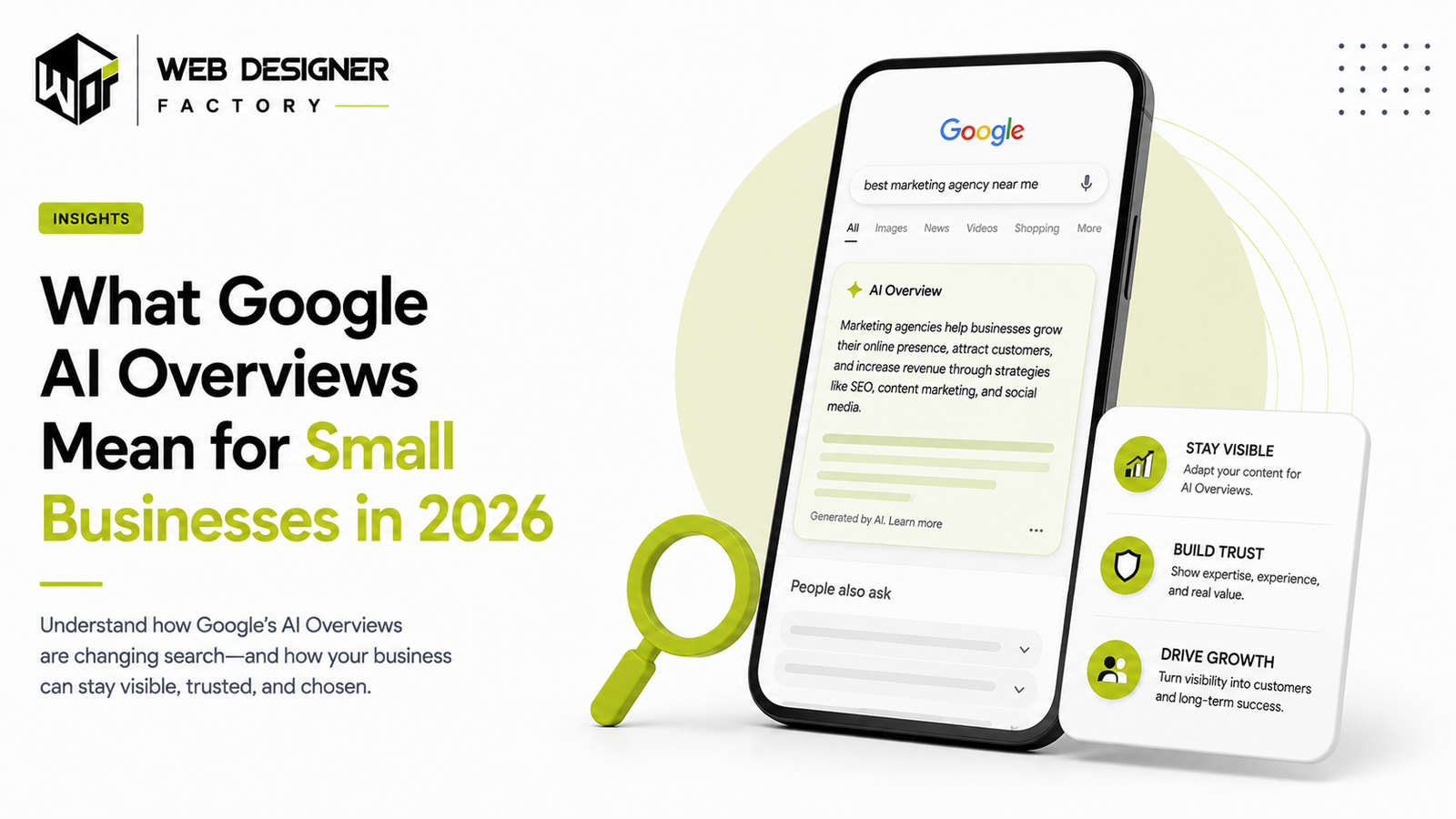
Google AI Overviews are generated summaries that can appear above or among traditional results. For a small business, the practical change is that useful information may be summarized before a searcher clicks. The technical foundation does not change: Google says ordinary SEO best practices still apply. See Google’s AI-feature guidance.
What Google says is required
A page must be indexed and eligible to appear with a snippet. Google recommends crawlable pages, useful text, good internal links, strong page experience, high-quality media where helpful, and structured data that matches visible content. It does not require special AI schema, an AI-only text file or a separate version of the page. These requirements come from Google Search Central.
Why one query can surface several sources
Google describes “query fan-out,” where an AI feature may issue related searches across subtopics and data sources. That makes narrow, genuinely useful supporting pages valuable when they answer a distinct question. It does not justify publishing many near-duplicate pages around the same phrase. Google describes query fan-out here.
What small businesses should improve
- Answer the core question early, then add scope, evidence and limitations.
- Keep services, locations, people and business facts explicit and consistent.
- Use primary sources for changing facts and show a truthful update date only after a real refresh.
- Connect supporting articles to the correct commercial owner with contextual links.
How to measure the effect
Google includes AI-feature traffic in Search Console performance reporting. Compare impressions, clicks, queries and landing pages over useful periods, and remember that page-level data is aggregated to canonical URLs. A traffic change does not prove one article or one AI feature caused it. See Google’s reporting announcement.
AI Overviews change the result page, not the need for a useful source
An AI Overview can summarize a complex question and link to supporting pages. It does not appear for every query, and the links can differ because Google uses different models and techniques. A business should focus on eligibility and source value rather than trying to force a specific result format. Google’s documentation explains these differences.
Query fan-out broadens the evidence a page may need
Google says AI features may issue several related searches across subtopics and data sources. A page can support that process by answering the main question, explaining meaningful subquestions, naming entities and relationships, and linking to deeper canonical resources. This is a content-quality reason to cover a topic coherently, not a license to add unrelated keywords. See the query fan-out explanation.
Review the pages that support a real decision
- Make the answer and its conditions clear near the relevant heading.
- Add information competitors commonly omit, such as limitations, operating tradeoffs, implementation steps or original evidence.
- Keep important facts visible in text and support them with useful images or video where appropriate.
- Use structured data that matches visible content and current eligibility rules.
- Connect the page to its supporting and canonical commercial owners through contextual links.
Control preview and training access deliberately
Google documents noindex and snippet controls for managing Search presentation, while Google-Extended addresses some other AI training and grounding uses. These controls serve different purposes. Test the actual crawler response and document the publishing decision before changing them. Google’s content-control guidance distinguishes these controls.
Measure business impact with the available evidence
Google’s June 2026 announcement, updated August 31, says its dedicated generative AI performance reports have rolled out to websites worldwide. They show impressions and the pages surfaced, with country, date, and relevant device views; the data also remains in overall performance reporting. Combine those views with qualified website activity and customer inquiries when assessing business impact.
Know what cannot be promised
Indexing, inclusion, citation and clicks are not guaranteed. A cited source may receive little traffic, and a traffic change does not prove an AI Overview caused it. Record dates, queries, devices, locations and result states when making observations.
The AI search optimization guide owns the broader program. This article stays focused on Google’s AI Overview result format and its practical implications.
For the broader cross-platform system, continue to the AI search optimization guide. This page remains Google-specific.
Sources and methodology
This article uses Google’s AI-feature documentation and Search Console’s generative AI reporting announcement, including its August 31, 2026 rollout update. Page-planning and measurement recommendations are Web Designer Factory practitioner guidance. Report changes alongside site, demand, and campaign context rather than attributing an outcome to one edit.