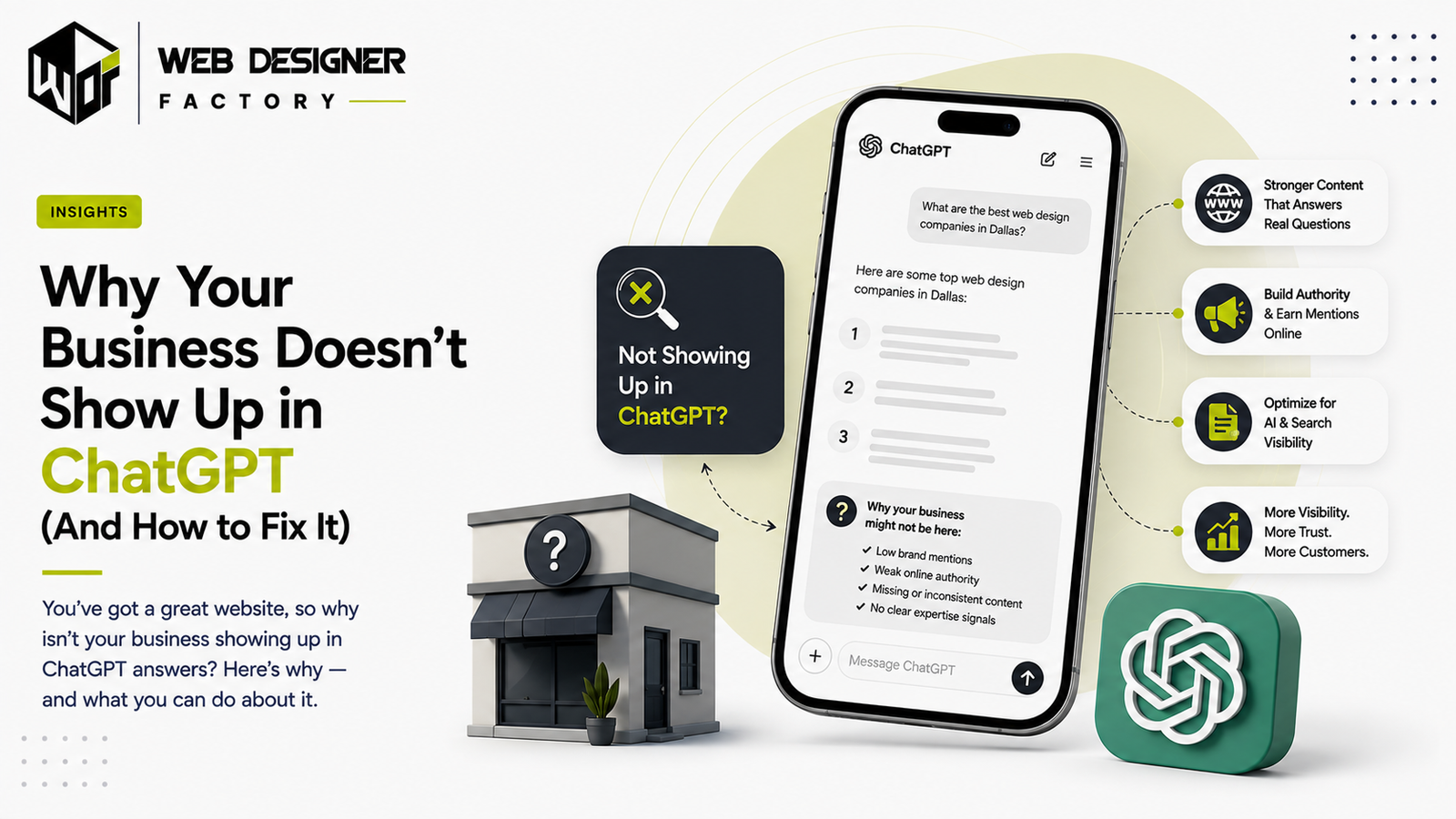
If your business never comes up when someone asks ChatGPT for a recommendation, the cause usually isn't bad luck. It's one or more specific gaps in how AI systems read, trust, and verify a business online. There is no submission process and no algorithm to unlock. AI visibility is built the same way SEO authority is built: through consistent information, real expertise, and content AI systems can actually use.
Five Issues Worth Checking When Your Business Does Not Appear in ChatGPT
AI systems are designed to provide useful, reliable answers. If your business is absent, these five issues are worth checking because each can limit how clearly a system can identify, understand, or verify the business.
1. The website lacks credibility signals
An outdated site, thin content, or vague service descriptions give AI nothing solid to point to. A homepage that says little about a business's actual experience gives an AI system no reason to treat that business as a reliable source.
2. Business information is inconsistent across the web
If a company name, phone number, or address differs between the website, directories, and social platforms, AI systems have a harder time confirming who a business is. Small mismatches, an old suite number, a phone line that's no longer in service, quietly work against a business's visibility.
3. No educational content beyond a list of services
A service page alone doesn't demonstrate expertise. Businesses that answer real customer questions through guides and articles give AI systems useful context about what they know and how they help. Without that content, an AI system has very little to learn from beyond a short services list.
4. Content has no specific, checkable detail
The 2024 KDD paper GEO: Generative Engine Optimization, written by researchers affiliated with Princeton University and IIT Delhi alongside independent researchers, introduced GEO-bench: a dataset of 10,000 queries across 25 domains. The reported method comparisons used the benchmark's test split in a controlled generative-engine setup. Its table shows the overall position-adjusted word-count visibility score rising from 19.3 to 27.2 with quotation addition and to 25.2 with statistics addition, improvements of about 41 percent and 31 percent in that experiment. These are experimental visibility measures, not general probabilities that ChatGPT will cite or recommend a business.
5. The website is hard for AI systems to read
Slow load times, missing structure, and a lack of clear labeling, such as schema markup, make it harder for AI systems to understand what a page is actually about. A page that's confusing for search engines to parse is just as confusing for the AI models that rely on the same underlying information.
How to Improve AI Visibility
Build trust through E-E-A-T
Google's Experience, Expertise, Authoritativeness, and Trustworthiness framework is becoming relevant beyond traditional search. OpenAI hasn't stated that ChatGPT directly uses Google's framework, but the same trust signals that support SEO also build credibility across the web generally. Detailed service pages, case studies, testimonials, and a genuinely informative About page all give AI systems, and human readers, something concrete to evaluate.
Publish content that solves real problems
Businesses often write only about themselves. Content that answers the questions customers are already asking, explaining a process, comparing options, walking through a decision, shows real expertise and increases the odds of being referenced in an AI-generated answer. Every piece should have a clear purpose rather than repeating a sales pitch.
Strengthen the technical foundation
Fast load times, a mobile-friendly layout, secure connections, and a logical site structure all contribute to a better experience for visitors and for the systems reading the page. Schema markup labels information like services, business details, and FAQs in a structured format. Yext's AI Citations, User Locations, & Query Context research analyzed 6.8 million citations from roughly 1.6 million API responses across Gemini, OpenAI, and Perplexity. The responses were collected in July and August 2025 for location-focused queries across finance, food, healthcare, and retail. In that dataset, sources brands owned or could manage or influence accounted for approximately 86 percent of consumer-facing citations. That result supports maintaining accurate websites and listings within the study’s scope; it does not show that a business directly controls most AI visibility across every product, industry, or query.
AI Search Optimization Is Becoming Part of Ordinary SEO
This doesn't mean abandoning traditional SEO. It means keeping the technical fundamentals, helpful content, and consistent business information that already support search rankings, while paying closer attention to whether that information is specific and structured enough for AI systems to use. Businesses that build genuine credibility now will be in a stronger position as AI-powered search keeps evolving.
Sources and methodology
GEO: Generative Engine Optimization (KDD 2024) used GEO-bench and a controlled generative-engine evaluation. Its percentage changes describe experimental visibility metrics, not guaranteed ChatGPT citation or ranking outcomes.
AI Citations, User Locations, & Query Context (Yext, 2025) analyzed API-produced responses for Yext clients and prospects across four industries and location contexts. Yext notes that API citations may differ from those shown in consumer applications and that results vary by model and user context.